

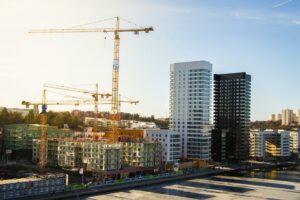
Natural stone has returned to centre stage in contemporary architecture. Ventilated façades in marble and granite, stone cladding on prefabricated modular structures, prestigious architectural elements. But behind every stone surface that endures over time, there is a high-strength anchoring system that made its installation possible and guarantees its safety throughout the entire useful life of the structure.
Marble, granite, natural stone and engineered stone materials are today among the reference choices for architectural and interior design projects. Their presence has extended well beyond traditional applications — flooring, horizontal cladding, decorative elements — to reach structurally more demanding contexts.
This expansion of applications brings with it a technical complexity that requires particular attention at the design stage. Natural stone is a material of great aesthetic value and intrinsic durability, but its mechanical behaviour differs significantly from that of traditional industrial materials. It is heavy, brittle under point loads, heterogeneous in its internal structure, and responds unpredictably to stress concentrations that other materials would absorb without visible consequences.
In this context, the anchoring system is what makes the application possible — and what determines its safety, durability and long-term reliability.
Why stone materials require specific high-strength anchoring systems
Three characteristics of stone materials define the technical requirements for anchoring systems.
Brittleness and sensitivity to stress concentration
Natural stone has high compressive strength, but significantly lower tensile and flexural resistance. This means that a localised stress concentration — generated by an incorrectly dimensioned anchor, an improperly executed hole, or an insert that transfers loads unevenly — can cause micro-cracking or failure of the material at the fixing point, often without visible warning signs.
Anchoring systems for stone must therefore be designed to distribute the load over an adequate contact surface and avoid pressure concentrations on the hole walls, in order to make the best use of the material’s tensile strength.
Internal material variability
Natural stone is not homogeneous. Veining, inclusions, density variations and differences in mineral composition can be present even within the same block or slab. This heterogeneity makes the mechanical behaviour of the material at the anchoring point partially unpredictable, and requires the adoption of fastening systems that are tolerant of substrate variations and do not require ideal conditions to guarantee their effectiveness.
High weight and significant permanent loads
Marble and granite have densities between 2,600 and 2,900 kg/m³. A 30mm thick granite slab of 1m² weighs approximately 80kg. In a ventilated façade, each stone panel generates a permanent load that must be transmitted to the load-bearing structure through the anchoring points, throughout the entire useful life of the building — which is measured in decades.
Anchoring systems must therefore guarantee long-term holding performance, corrosion resistance in exposed environments, and compatibility with the differential movements generated by thermal variations between the stone material and the load-bearing structure to which it is connected.
Three key applications in the contemporary construction context
Ventilated façades
The ventilated façade is today one of the most widespread and technically demanding applications for stone anchoring systems. In this system, natural stone panels are fixed to a metal substructure that creates a ventilated air gap between the external cladding and the load-bearing wall, improving the thermal, acoustic and durability performance of the building envelope.
The anchoring requirements for this application are numerous: the system must transmit tensile loads—due to the weight of the panel—and shear loads—caused by wind—without creating stress concentrations in the stone. It must also ensure this performance in an environment exposed for decades to thermal cycles, humidity, atmospheric agents, and salts.
Modular and prefabricated structures
The growing adoption of modular and prefabricated construction systems is bringing stone materials into a very different production context from the traditional one. Instead of being installed on site slab by slab, stone is increasingly applied to prefabricated elements — composite panels, prefabricated façades, three-dimensional elements — which are then transported and assembled at the construction site.
This approach introduces specific requirements for anchoring systems. Repeatability is essential: the same anchoring system must produce identical results across thousands of pieces, with precise dimensional tolerances that allow for on-site assembly without adjustments. Installation speed is critical, as the production process is optimized to avoid complex or time-consuming anchoring operations.
Building recovery and restoration
Italy’s building stock — historic, industrial and post-war — is the subject of growing recovery, regeneration and enhancement interventions, including for energy efficiency purposes. In many of these projects, existing stone materials must be consolidated, integrated or partially replaced, with the constraint of not compromising the original surfaces and of operating on substrates that may be degraded, non-homogeneous or difficult to access.
In this context, anchoring systems meet a set of requirements that are often conflicting: drilling must be limited to the minimum necessary to avoid weakening the original material; the fastening system must adapt to substrate variations (irregular thicknesses, internal discontinuities, zones of lower resistance) without requiring ideal conditions; and the final result must be aesthetically discreet, with the fixing completely hidden or with minimal visual impact on the surface.
Specialinsert® solutions for stone fastening
Specialinsert® offers a range of fastening systems specifically developed for applications on marble, granite, natural stone and engineered stone materials. The portfolio responds to today’s diverse application needs with solutions that can be standard or custom-developed according to the specific project.
Press-in threaded inserts — KEEP-NUT® — the self-anchoring press-in system for creating reliable threaded seats on marble, granite, natural stone, composites, Corian® and HPL. Installation is achieved by simple pressure, without the need for specialist equipment or complex slab processing. The system guarantees a solid mechanical anchor that distributes load across the hole wall, avoiding stress concentrations on the stone material.
Bonding bushes, studs and nuts — MASTER-PLATE®
Bonding fastening systems applicable to any type of stone material, without the need for drilling. The solution for cases where drilling is not feasable— such as surfaces that are too thin, particularly fragile materials, or restoration work on valuable elements — or when the aesthetic requirement demands the complete absence of any visible processing on the surface.
In specific applications, mechanical anchoring systems can be integrated with structural chemical adhesives to achieve superior holding performance or to consolidate anchors in particularly critical substrates. In these cases, the choice of adhesive system must be coordinated with the mechanical system specification to ensure chemical compatibility with the stone material and the exposure conditions.
The anchoring system belongs in the design process from the start
The practical conclusion of this scenario is the same that emerges in every application where materials and performance requirements are demanding: the anchoring system cannot be a decision made downstream of the project. It must enter the design process alongside other technical choices — stone type, slab thickness, façade system, joint details — because it influences construction feasibility, structural safety, long-term durability and the real cost of the intervention.
With the growing popularity of ventilated stone façades and modular construction, this expertise is becoming increasingly strategic for designers and structural engineers working with premium materials.
