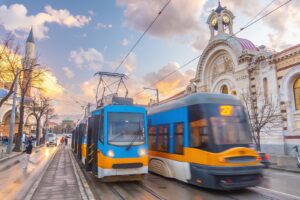
Urban public transport is undergoing structural transformation. Fleet electrification, expansion of metro and tram networks, and the growing adoption of composite materials for weight reduction and sound insulation. In this context, fastening systems are increasingly taking on the role of structural and functional components that must perform across millions of cycles, in aggressive environments, and under stringent maintenance constraints.
Urban public transport is one of the fastest-growing industrial sectors globally. According to estimates from the International Association of Public Transport (UITP), the number of passengers carried by urban public transport in major European cities exceeds 60 billion per year, with a steadily growing trend driven by decarbonisation policies and the progressive reduction of private traffic in city centres.
Across Europe, investment in new metro and tram lines and bus fleet renewal has increased significantly over the past decade. All major cities are expanding their rapid mass transit networks, while dozens of medium-sized cities are reintroducing the tram as a sustainable urban mobility solution. At the same time, bus fleet electrification is accelerating across Europe, with zero-emission targets for urban public transport set by numerous national governments for 2035–2040.
In this context, vehicle weight reduction has become a technical and economic priority. Every kilogram eliminated from the structure of a bus or metro carriage — without compromising safety — translates into lower energy consumption, greater range, and reduced infrastructure wear. Composite materials, lightweight alloys and hybrid structures are progressively replacing traditional materials in components that were once considered immutable. And with the materials, the requirements for fastening systems have changed too.
The specific challenges of the sector
Fastening systems for urban public transport operate under conditions that combine some of the most demanding stresses in mechanical engineering. Five cross-cutting challenges define the requirements of this sector.
Continuous vibration and mechanical fatigue
An urban public transport vehicle covers many tens of thousands of kilometres per year on routes that include rails, discontinuous road surfaces, junctions and repeated speed changes. The vibrations generated by motion are transmitted to every structural component, creating cyclic stresses that over time can cause joint loosening, material fatigue and progressive fastener failure. Fastening systems for this sector must be designed to withstand millions of load cycles without loss of grip.
Corrosion in aggressive environments
Cities are among the most corrosively aggressive environments: tunnels with high humidity and poor ventilation, exposure to rain and atmospheric agents, de-icing salts on roads during winter months, exhaust residues and brake particulate, and in general the pollutants characteristic of large cities. Fastening systems must maintain their structural integrity performance throughout the entire useful life of the vehicle — which in public transport is measured at 25–30 years — or in any case in line with programmed maintenance cycles.
Structural weight reduction and energy saving
Weight reduction is now universally recognised as one of the main priorities in the design of contemporary public transport vehicles. The adoption of aluminium, carbon fibre and glass fibre composites, and sandwich structures has significantly reduced bodywork weight compared to previous generations. Fastening systems must be compatible with these materials — and contribute themselves to the lightweighting objective, without compromising structural resistance. Every gram saved on fastening components, multiplied by the thousands of fastening points on a single vehicle and by the kilometres travelled, produces a measurable impact on energy consumption and range.
Passenger acoustic comfort
Acoustic comfort has become an explicit design requirement in urban public transport. European regulations and public authority specifications include precise limits on noise levels perceived by passengers inside vehicles. Fastening systems play a direct role in this context: a poorly dimensioned or loosened joint generates noise, vibrations transmitted through rigid fastening points translate into structural noise, and the choice of fastening materials and geometries influences acoustic transmission between panels. Interior cladding, flooring, wall panels and ceilings must be fastened with systems that also perform a vibration-damping function.
Maintenance accessibility
Urban public transport vehicles require frequent and programmed maintenance. Downtime is costly and has a direct impact on the network’s operational capacity. Fastening systems must allow the rapid replacement of consumable components. In many cases, this means designing for maintenance from the vehicle development stage.
Application differences by vehicle type
Buses and electric buses
The contemporary urban bus is an increasingly complex vehicle from the perspective of materials and components. Modern bodyworks combine steel load-bearing structures with aluminium and composite panelling, lightweight interior cladding, and rubber or composite flooring. Electrification has added a new category of critical components that require specific fastening solutions to manage weight, vibration and replacement needs over the vehicle’s lifetime.
Furthermore, the interiors of modern buses are designed as modular systems: seats, panels, handrails, floor and ceiling cladding must be replaceable or upgradeable without structural intervention. This requires fastening systems that are fast, reliable and accessible from one side only, compatible with different materials and with variable assembly tolerances.
Trams
The contemporary tram is a hybrid vehicle by definition: steel or aluminium load-bearing structure, composite and aluminium bodywork, low floor that imposes stringent geometric constraints on under-floor components, and interface with urban infrastructure through the rail and overhead catenary system. The progressive adoption of full low-floor trams has made the design of interior spaces and associated fastening systems more complex, reducing available space and increasing maintenance access constraints.
Tram interior cladding must simultaneously meet aesthetic and functional requirements: wear resistance, ease of cleaning, and rapid replacement in the event of vandalism or wear damage.
Metros and light rail
Metros and light rail for urban commuting — such as the Paris RER, the Berlin S-Bahn or Italian suburban lines — operate under far more intensive load conditions than other urban public transport vehicles, with very high service frequencies and passenger numbers measured in millions per year per single line.
The applicable regulations are the most stringent in the sector: European Technical Specifications for Interoperability (TSI), EN 45545 fire resistance standards for materials, and structural component homologation requirements. Materials must be fire-certified, fastening systems must be traceable and verifiable, and maintenance cycles are precisely scheduled and must be executable within available downtime windows — typically overnight and of short duration.
The growing role of composite materials
The adoption of composite materials in urban public transport has accelerated significantly in recent years: glass and carbon fibre panels, sandwich structures with foam or honeycomb cores, HPL cladding and laminated composite materials are now present in growing quantities in the interiors and secondary structures of buses, trams and metros.
Composites pose specific challenges for traditional fastening systems: they do not allow the machining operations typical of metallic materials, they have anisotropic behaviour that varies according to fibre orientation, and they require solutions that distribute load without creating stress concentrations that could cause delamination or cracking of the material.
For a detailed discussion of the specific requirements of fastening systems for composite materials, see the dedicated article on the Specialinsert® blog: The importance of fastening systems with composite materials.
Specialinsert® solutions for urban public transport
Specialinsert® has been developing fastening systems for the transport sector for decades, with solutions that address the specific challenges of urban public transport vehicles. The portfolio for this sector includes both standard products and custom developments, designed to respond to concrete technical problems.
FAST-CON® — the stainless steel snap-fit quick fastening system for panelling and cladding. It allows interior panels to be attached and removed by simple pressure or light traction, without tools. The direct response to the need for rapid maintenance of interior cladding in buses, trams and metros, with a completely surface-invisible fastening and the possibility of panel replacement without structural intervention.
DEFORM-NUT® Self-Locking — when working on hollow sections, tubes or profiles whose interior is inaccessible, traditional fastening becomes extremely complex. DEFORM-NUT® Self-Locking combines a deformation rivet and a self-locking nut: a deformable tubular rivet with a patented self-locking thread — available in cylindrical or hexagonal versions with a nylon ring — that guarantees anti-loosening without additional components such as thread-locking compounds or spring washers. Installable on hollow sections, tubes, laminates and profiles without internal access, it allows rapid assembly of the connecting screw without the use of two spanners. Available in zinc-plated steel and stainless steel, in various geometries. An ideal solution for the numerous fastening points on public transport structures subject to continuous vibration.
CROWN-NUT® — a specific solution for creating threaded seats at the head of round and square tubes, without resorting to welding or crimping. Thanks to the elasticity of the crowns, the system adapts to wide internal diameter tolerances — up to approximately 2 mm variation — resolving issues related to production inconsistencies and possible diameter restrictions caused by tube welding. Press-fit insertion is gradual, simple and fast, does not damage or alter the receiving material, and meets aesthetic criteria. Particularly suitable for tubular structures found in public transport vehicles.
DEFORM-NUT® TC/SC 1 — extra-short knurled threaded tubular rivets for sandwich panels, available with cylindrical or flush head. The patented system creates reliable threaded seats in honeycomb or composite structure panels, on any composite material, resins, carbon fibre and lightweight alloys. Compared to traditional solutions — resin potting or bonded bush insertion — it offers immediate mechanical fastening without waiting time, compatibility with a variable range of panel thicknesses, and fast installation requiring no specialist personnel or subsequent finishing operations. Assembly can be integrated into automated production lines. Also used on the Miacore™ ultra-lightweight composite panel by Bencore®.
ENSAT® 309 — brass self-threading bush for thermoplastic materials, wood and derivatives, and composite materials. A metal insert with internal and external thread and tapping slots, designed to create high wear-resistance threaded seats in low-resistance materials. Applicable to finished parts, it eliminates positioning errors and material deposits in the thread. The speed and simplicity of installation — a standard tolerance hole is sufficient — make it a cost-effective and efficient solution for the composite and plastic components increasingly present in urban public transport vehicle interiors.
MASTER-PLATE® — threaded bushes and pins for bonding, applicable to any type of material. The solution for fastening points where drilling is not practicable or desirable, with rail, marine and transport among the product’s key reference industries.
Standards and certifications: a non-negotiable requirement
In urban public transport, the client is almost always a public authority or a publicly owned company. This often implies homologation and certification processes more stringent than in other sectors, extending to fastening components as well.
Component traceability, production process documentation, and the availability of recognised quality certifications are indispensable requirements for accessing supply chains in the public transport sector. For a detailed discussion of quality certifications in fastening systems, see the dedicated article: The importance of quality certifications in the fastening systems industry.
Fastening system selection belongs in the vehicle development process
The practical conclusion of this scenario is the same that emerges in every sector where materials and performance requirements have evolved rapidly: the choice of fastening system cannot be a decision made downstream of the project. It must enter the vehicle development process alongside other technical choices — materials, structural geometry, production process, maintenance strategy.
Urban public transport vehicle manufacturers who integrate fastening expertise at the early stages of design achieve concrete advantages: lighter solutions, faster maintenance, more robust regulatory compliance, and a more controlled supply chain.
For designers and R&D teams working in this sector, Specialinsert® is available for a technical assessment of the specific application. The starting point is not a catalogue, but a conversation about the real problem.
To find out more about the applications of fastening systems in rail transport, read also: Fastening systems for rail transport: all the aspects to consider