

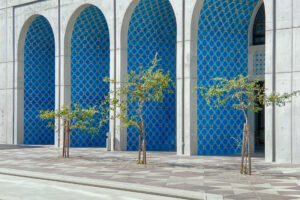
Natural stone has always been a constant presence in design. In recent years, however, its functions in design and the ways it is used have evolved. The questions that designers ask of those tasked with transforming their ideas into concrete, lasting solutions have also changed..
Stone reinvents itself
It is almost paradoxical that natural stone has returned to the centre of contemporary interior and exterior design. In an era defined by engineered materials, synthetic surfaces and industrial reproducibility, marble, granite, travertine and engineered stone are experiencing a season of renewed prominence as a genuinely contemporary design choice.
In international luxury markets — and particularly in the Middle East, where representative architecture is a cultural language before it is an aesthetic one — natural stone has become the reference material for projects that want to communicate permanence, quality and identity. Private residences, luxury hotels, corporate headquarters, public spaces: in all these contexts, stone today is more than a cladding material.
But the stone that designers choose today is not the same as it was twenty years ago. The formats have changed, the finishes have changed, and so have the application contexts. And with them, the technical challenges that those who work with this material must face have changed too.
The aesthetic trends defining the natural stone sector
Tactile and matte finishes
Mirror polishing, long a synonym for luxury in the stone sector, has given ground to finishes that enhance the material’s texture rather than its reflective capacity. Brushed finishes, matte honing, bush-hammered or flamed surfaces: contemporary stone wants to be touched as well as seen.
This trend reflects a deeper shift in the way luxury is understood: less ostentation, more sensoriality. The matte surface reveals the material’s internal structure, its veining, inclusions, the heterogeneity that makes every slab unique. And in environments where natural and artificial light is precisely designed, a surface that diffuses rather than reflects light becomes a compositional instrument in the architect’s hands.
Large formats and visual continuity
One of the most radical transformations in stone design in recent years is the elimination of the joint as a visible element. Ever-larger slabs — in some cases exceeding 3 metres in length — allow floors, walls and ceilings to be clad with a visual continuity that brings the stone surface closer to a painted backdrop than a modular cladding system.
In contemporary luxury spaces, this continuity has become an essential design requirement: marble veining that crosses a floor without interruption, granite patterns extending seamlessly from one wall to another. Stone as an infinite surface — or at least as the illusion of one.
Ultra-thin panels
Stone processing technology has made possible what once seemed impossible: marble and granite slabs with thicknesses of 3, 6 or 12 millimetres, without losing the structure and distinct character of the natural material. Ultra-thin panels have opened a new universe of applications for natural stone: furniture cladding, kitchen and bathroom surfaces, lightweight façade elements, high-end interior design panels.
This format also serves a functional purpose: reducing the weight of stone means it can be applied in structurally more delicate contexts, on supports that could not bear the weight of a traditional slab. Ultra-thin stone also becomes a viable option for projects that, for structural or logistic reasons, would otherwise have been unable to use it.
Material mix
Contemporary design of excellence has abandoned mono-material purity in favour of hybrid compositions in which stone engages in dialogue with metal, glass, wood, composites and technical materials.
These combinations are not merely aesthetic — they reflect a construction philosophy in which materials with different properties are combined to achieve performance that none of them could deliver alone. Stone brings visual weight, durability and identity. Metal brings structural lightness and precision. Glass brings transparency and light.
Stone in extreme environments
One of the most significant phenomena in contemporary stone design is the expansion of natural stone into application once considered impractical: external façades in coastal environments where salt-laden humidity is constant; outdoor surfaces in climates with significant thermal fluctuations; cladding in settings where the combination of heat, humidity and solar radiation tests the durability of any material.
In these contexts — particularly relevant in the Middle East and Southeast Asian markets — natural stone is chosen for its ability to age without degrading, to maintain its aesthetic identity over time, to withstand environmental stress better than many ‘artificial’ alternatives. But this choice carries precise technical requirements that must be anticipated at the design stage.
Digital customisation
CNC and water-jet processing technologies have finally transformed stone from a material of conventional forms into a surface of almost unlimited design expression. Non-standard geometries, customised textures, patterns following parametric logic, drillings and inlays that create light and shadow effects impossible with traditional processing.
This unprecedented design freedom is also a technical challenge: a slab that has been drilled, shaped or lightened by complex processing has a different internal structure from an intact slab, with zones of lower resistance that must be considered when designing the anchoring system.
When design changes, fastening changes too
Every aesthetic choice described above carries a technical consequence that must not emerge only at the execution stage, when the project is already defined and the options have narrowed. The most effective way to avoid this is to treat the fastening system as an integral part of the design decision.
The visual continuity of large formats requires the fastening to disappear completely from the surface. It is not simply a matter of choosing a discreet insert, but of designing an anchoring system that leaves no visible trace, does not alter the planimetry of the surface and creates no discontinuity in the stone pattern. Solutions such as KEEP-NUT® — Specialinsert®’s self-anchoring press-in insert — respond to this requirement by creating reliable threaded seats without compromising the integrity of the stone surface.
Ultra-thin panels pose a radically different problem: the space available for fastening is reduced to a minimum, and the relative fragility of the slab does not tolerate the localised stress concentrations typical of traditional solutions designed for standard-thickness slabs. In these cases, bonding anchoring systems such as MASTER-PLATE® — bushes and studs that fix by adhesion without drilling — offer a response that respects both the material and the aesthetic requirement.
The material mix introduces the challenge of compatibility: when stone and metal meet in a hybrid composition, the fastening system must manage very different mechanical behaviours — different thermal expansions rates, different stiffness, vibration sensitivities that do not overlap. The choice of anchoring system becomes a joint engineering decision, not merely an assembly one.
Circular economy and disassembly — a growing trend that European regulation is making increasingly binding — completely changes the logic of stone anchoring. A system designed to be permanent is fundamentally different from one designed to be removed, with the material potentially recovered and reused. Snap-fit systems and quick-fastening solutions such as FAST-CON® — which allow panels to be connected and removed by simple pressure or traction — open natural stone to a design dimension that until recently was unthinkable: reversibility.
Stone in extreme environments, finally, requires the fastening system to be designed for the same exposure conditions as the material itself. Salt corrosion, significant thermal cycles, UV radiation: these factors affect not only the stone, but every component of the construction system — including inserts and anchors. The choice of fastening material — stainless steel, titanium, special alloys — becomes as much part of the design specification as the choice of stone finish.
The right conversation at the right time
The most ambitious project with natural stone deserves all its variables — aesthetic, structural and technical — to be considered together, from the earliest stages of development. The fastening system is not the final detail: it is the condition that makes the design vision achievable.
Contact our technical team to find the best fastening solution for your design needs.
